
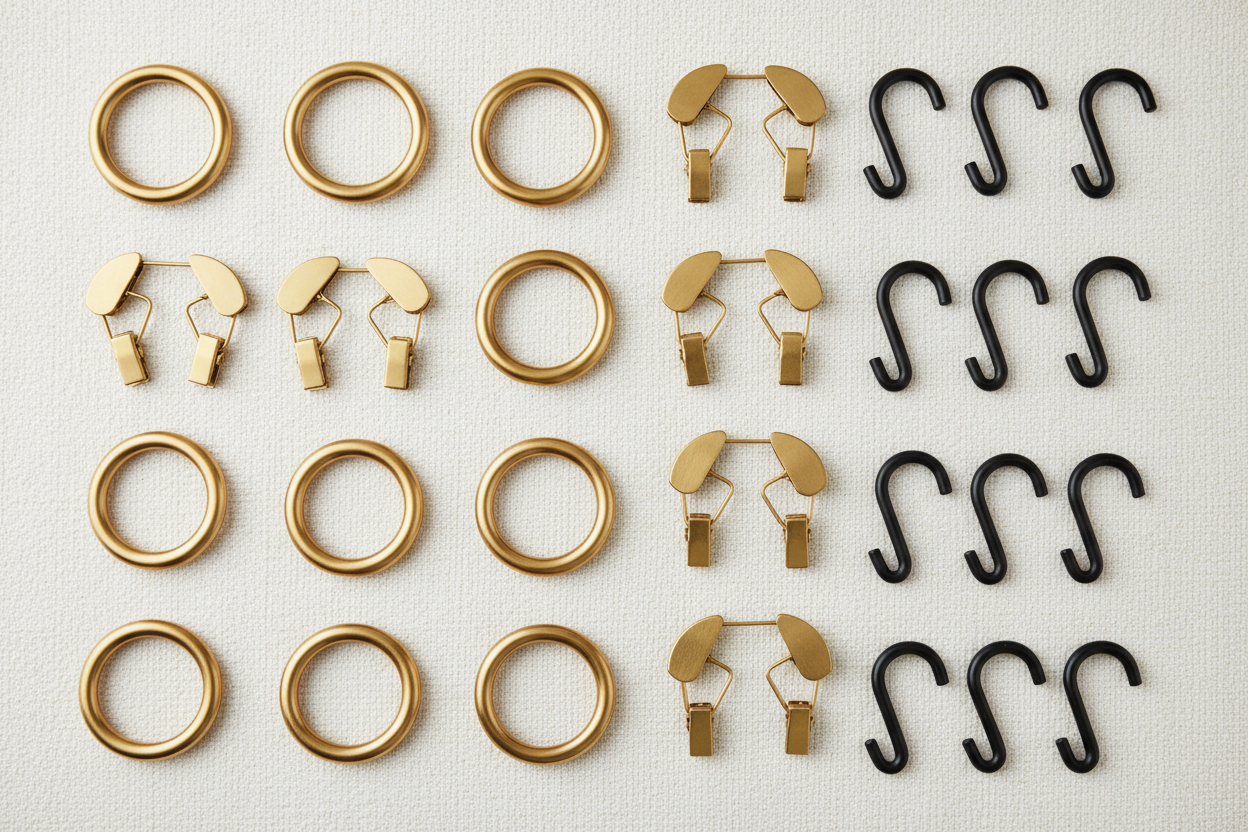
The Role of Rings and Hooks
Rings and hooks are the small but essential connectors between your curtain and its rod or track. Choose the right ones and your curtains will hang perfectly, slide smoothly, and look polished. Choose the wrong ones and you'll have uneven drops, difficult operation, and hardware that doesn't match your aesthetic.
This guide covers the main types and how to select the right combination for your curtains.
Curtain Rings
Rings attach to the rod and hold the curtain hook or clip. They come in several styles:
1. Standard Curtain Rings
A simple ring with an eyelet at the bottom through which a curtain hook is inserted. The most common type for pinch pleat and pencil pleat curtains.
- Best for: Pinch pleat, pencil pleat, and any hook-hung curtain
- Key spec: Inner diameter must be larger than the rod diameter so the ring slides freely
- Tip: Choose rings with a smooth inner surface for easy gliding — avoid rings with seams that catch on the rod
2. Clip Rings
A ring with a small clip or clamp at the bottom that grips the curtain fabric directly, without needing a hook or header tape. Useful for hanging unlined panels or fabric without a formal header.
- Best for: Lightweight panels, linen sheers, informal or decorative curtains
- Limitation: Not suitable for heavy curtains — the clip may not hold securely under significant weight
3. Eyelet Rings (Built-In)
For eyelet curtains, the ring is built directly into the curtain header as a metal grommet. The rod threads through these grommets, so no separate rings are needed.
- Best for: Eyelet / grommet curtains only
- Note: Rod diameter must be smaller than the eyelet inner diameter for smooth operation
Curtain Hooks
Hooks insert into the header tape of the curtain and then hang from a ring or track glider. There are two main types:
1. Pin Hooks (Prong Hooks)
Small metal hooks with two or more prongs that pierce directly into the header tape. The most common hook for pinch pleat and pencil pleat curtains.
- Best for: Pinch pleat, pencil pleat curtains with woven header tape
- Advantage: Adjustable — inserting the prongs at different rows of the tape raises or lowers the curtain drop by 1–3cm, allowing fine-tuning after installation
- Tip: Insert all hooks at the same row of the tape to ensure an even drop across the full width
2. Sew-On Hooks
Hooks that are stitched directly to the back of the curtain header. More permanent than pin hooks but very secure.
- Best for: Bespoke or hand-finished curtains where a permanent, invisible fixing is preferred
3. Track Gliders (Runners)
Not hooks in the traditional sense, but the equivalent for curtain tracks. Gliders slot into the track channel and the curtain hook hangs from them. They allow smooth, quiet operation along the track.
- Best for: Any curtain hung on a track system
- Note: Gliders must be compatible with your specific track brand and profile
Matching Rings to Rods
The most important compatibility check is ring inner diameter vs. rod outer diameter:
| Rod Diameter | Minimum Ring Inner Diameter |
|---|---|
| 19mm | 22mm+ |
| 25mm | 28mm+ |
| 28mm | 32mm+ |
Allow at least 3–5mm of clearance between the rod and ring inner diameter for smooth sliding. Too tight and the rings will bind; too loose and they may rattle.
Finish Matching
Rings and hooks are visible hardware — especially rings, which sit above the curtain header. Always match the ring finish to your rod finish:
- Matte black rod → matte black rings
- Brushed brass rod → brushed brass or antique gold rings
- Chrome rod → polished or brushed chrome rings
- Natural wood rod → wood or complementary metal rings
Mismatched finishes are a common detail that undermines an otherwise well-executed installation.
How Many Rings Do You Need?
For pinch pleat curtains, you need one ring per pleat, plus one at each end of the curtain. As a rough guide:
- A standard single curtain panel (approx. 140cm wide, triple pinch pleat) typically requires 7–9 rings
- Always count your pleats and add 2 (for the leading and return edges) to get the exact number
Order a few extra — rings are inexpensive and having spares avoids delays if one is damaged or lost.

Leave a comment
This site is protected by hCaptcha and the hCaptcha Privacy Policy and Terms of Service apply.