
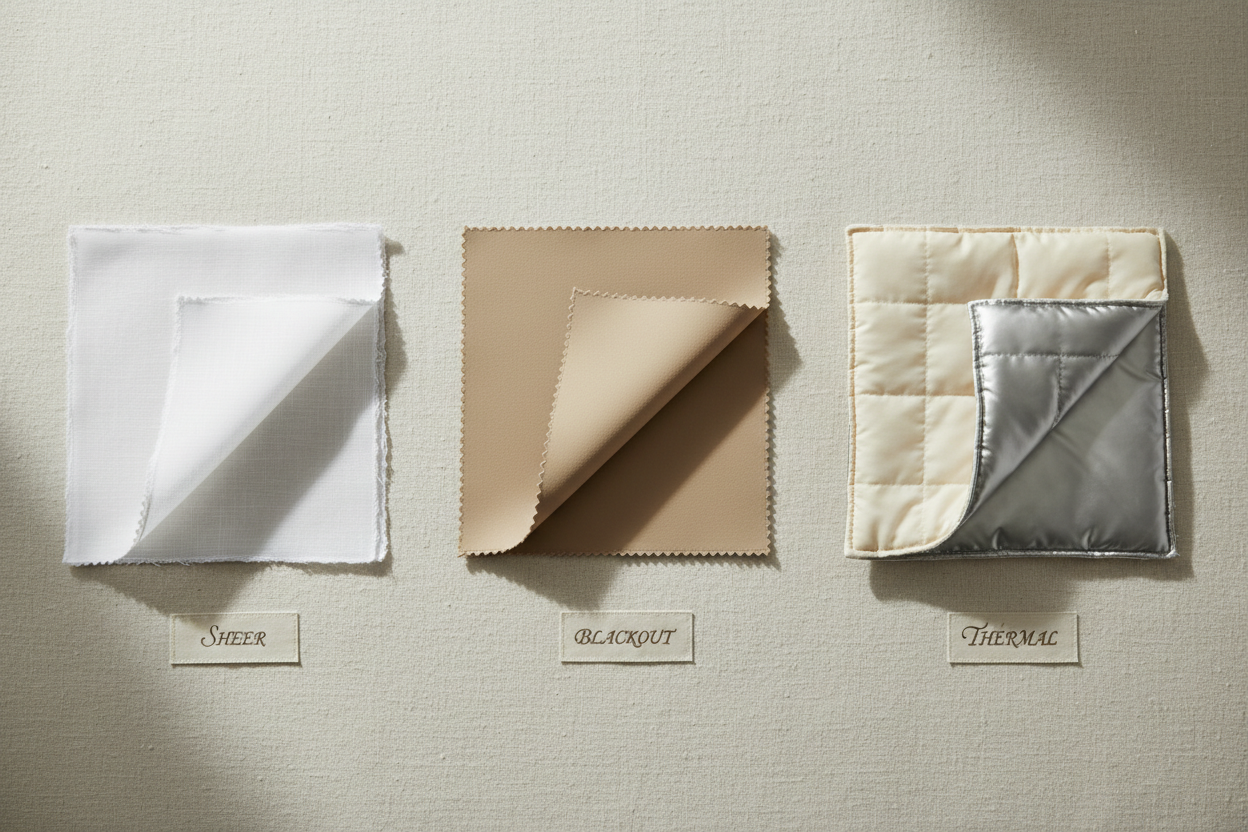
Why Lining Matters
Curtain lining is the hidden layer sewn to the back of your curtain fabric. It's one of the most practical decisions you'll make when choosing window treatments — affecting light control, insulation, privacy, fabric longevity, and how the curtain drapes and hangs.
Even the most beautiful fabric will underperform without the right lining. Here's everything you need to know.
The Main Types of Curtain Lining
1. Unlined
No lining at all. The curtain is a single layer of fabric.
- Best for: Sheer panels, lightweight decorative curtains, warm climates
- Light control: Minimal — sheers filter light but don't block it
- Insulation: None
- Note: Fabric is more exposed to sunlight and may fade faster
2. Standard Lining (Cotton Sateen)
A plain woven cotton or polyester lining in white or cream. The most common choice for everyday curtains.
- Best for: Living rooms, dining rooms, general use
- Light control: Reduces light, provides daytime privacy
- Insulation: Moderate — adds a layer of warmth
- Benefits: Protects the face fabric from UV damage, improves drape and body
3. Blackout Lining
A dense, tightly woven fabric — often with an acrylic foam coating — that blocks virtually all incoming light.
- Best for: Bedrooms, nurseries, home cinemas, shift workers
- Light control: Near-total blackout (95–100% depending on construction)
- Insulation: Good — also helps with noise reduction
- Note: Heavier than standard lining; requires sturdy rods and brackets
4. Thermal / Interlined
An extra layer of soft, wadded fabric (similar to batting) is inserted between the face fabric and the lining. This creates a luxuriously thick curtain with excellent insulating properties.
- Best for: Cold climates, period homes with draughty windows, luxury interiors
- Light control: Good, depending on face fabric
- Insulation: Excellent — significantly reduces heat loss
- Benefits: Adds weight and body, creating a sumptuous, hotel-like drape
5. Dim-Out Lining
A middle ground between standard and blackout. Dim-out lining significantly reduces light without achieving full blackout.
- Best for: Bedrooms where some morning light is acceptable, living rooms
- Light control: 70–90% light reduction
- Insulation: Moderate
- Note: A good compromise if full blackout feels too dark
How Lining Affects Drape
Lining adds weight to a curtain, which directly improves how it hangs. A lined curtain will always drape more elegantly than an unlined one in the same fabric. For pinch pleat curtains especially, lining is essential to achieving those clean, structured folds.
Interlining takes this further — the added bulk creates a full, rounded pleat that looks genuinely luxurious.
Lining and Fabric Longevity
UV light is one of the biggest enemies of curtain fabric. Over time, direct sunlight causes colours to fade and fibres to weaken. A good lining acts as a barrier, absorbing much of this UV exposure and significantly extending the life of your curtains — particularly important for premium fabrics like silk, linen, and velvet.
Choosing the Right Lining for Your Space
| Room | Recommended Lining |
|---|---|
| Master bedroom | Blackout or dim-out |
| Children's bedroom | Blackout |
| Living room | Standard or dim-out |
| Dining room | Standard or interlined |
| Home office | Standard or dim-out |
| Bathroom / kitchen | Unlined or standard |
Tessivra's Lining Options
All Tessivra curtains are available with your choice of lining — from our standard cotton sateen through to full blackout and luxurious interlining. We recommend blackout lining for bedrooms and standard lining for living spaces as a starting point, but our team is always happy to advise based on your specific room and fabric choice.
The right lining is invisible — but you'll feel the difference every time you draw your curtains.

Leave a comment
This site is protected by hCaptcha and the hCaptcha Privacy Policy and Terms of Service apply.